 About
About About
About Blog 2024
 Glossary
 Virtualism
 Questions
 Causation
 FAQs
FAQs Tools
Tools Truth
Truth Faery
Faery Memory
 Philosophy
 Science
 Religion
 Politics
 St Michael
 Tai Chi
 Answers
 Emergence
 Time
Time Iconism
 Alchemy
 Astrology
 Love
Love Death
Death Implications
 Birth Chart
 Examples
 Death
Death Politics
 Relationship
 Soldiers
 Sport
Sport Voyagers
 Fiction
 Planet Pairs
 Contact
 Speaking
 Why Donate
Under Construction
 Examples of Politics - Hiroshima and Enola Gay
What's in a name? That which we call a rose By any other name would smell as sweet - William Shakespeare - Romeo and Juliet
Index
Hiroshima's background
Hiroshima was the city in Japan that was destroyed by the first atomic bomb dropped by the USA during WWII. The bomb was dropped from a Boeing B-29 Superfortress named Enola Gay, after the mother of its commander, Colonel Paul Tibbets . She was born Enola Gay Haggard, in Iowa on 29 September 1892.
When looking at the events surrounding the bombing of Hiroshima, there are some strange factors that should be looked at. Notably the cases of Tsutomu Yamaguchi , who was present at both Hiroshima and Nagasaki, and survived both bombs; and that of Jacob Beser , who flew on both bombing missions.
Also, there is the story of Wilfred Burchett who was the first Western journalist into Hiroshima following the bombing, and who's report made a huge impact, given that it presented a 'warning to the World' that differed from the official line from the US Government.
What makes Hiroshima such a great example?
Hiroshima, the dropping of the bomb, makes a good astrological example, because it demonstrates the manner in which events that at first sight do not have anything to do with one another, actually are meaningfully connected. Without the birth of his mother, Col. Tibbets would not have been born, neither would the plane have been called Enola Gay.
19450726 Harry Truman and the Potsdam Ultimatum calling on Japan to Surrender
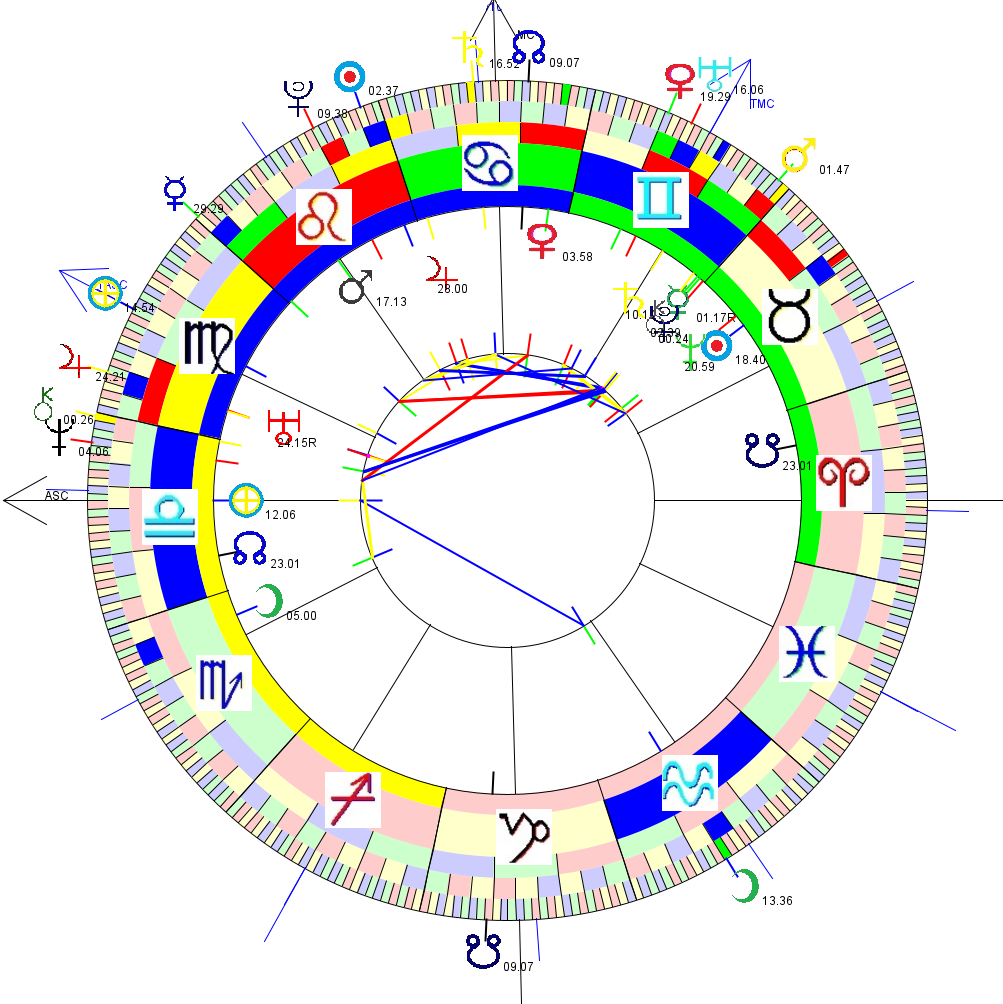
On 26 July 1945 President Harry Truman issued the Potsdam Declaration, which warned Japan of 'prompt and utter destruction' and required unconditional surrender of the Japanese armed forces. This was refused by Japan on the 29 July, which led to the bombing on the 6 August.
One of the first things to notice is that Truman was born with a conjunction of Mercury, Chiron and Pluto.
- Transiting Sun sextile Harry Truman's Mercury
- Transiting Sun sextile Harry Truman's Chiron
- Transiting Moon trine Harry Truman's Earth
- Transiting Mercury square Harry Truman's Mercury
- Transiting Mercury square Harry Truman's Pluto
- Transiting Mars conjunct Harry Truman's Mercury

- Transiting Mars conjunct Harry Truman's Pluto
- Transiting Mars conjunct Harry Truman's Chiron
- Transiting Jupiter conjunct Harry Truman's Uranus
- Transiting Saturn sextile Harry Truman's Sun
- Transiting Chiron trine Harry Truman's Mercury
- Transiting Chiron trine Harry Truman's Pluto
- Transiting Uranus sextile Harry Truman's Mars
- Transiting Neptune square Harry Truman's Venus
- Transiting Neptune trine Harry Truman's Chiron
- Transiting Pluto sextile Harry Truman's Saturn
In the chart shown here, the inner chart is the birth of Harry Truman, while the outer shows the date of the Potsdam ultimatum for Japan to surrender.
The outstanding feature here is that transiting Mars was conjunct natal Mercury, Chiron, and Pluto, for Harry Truman.
19450806 Hiroshima and Enola Gay
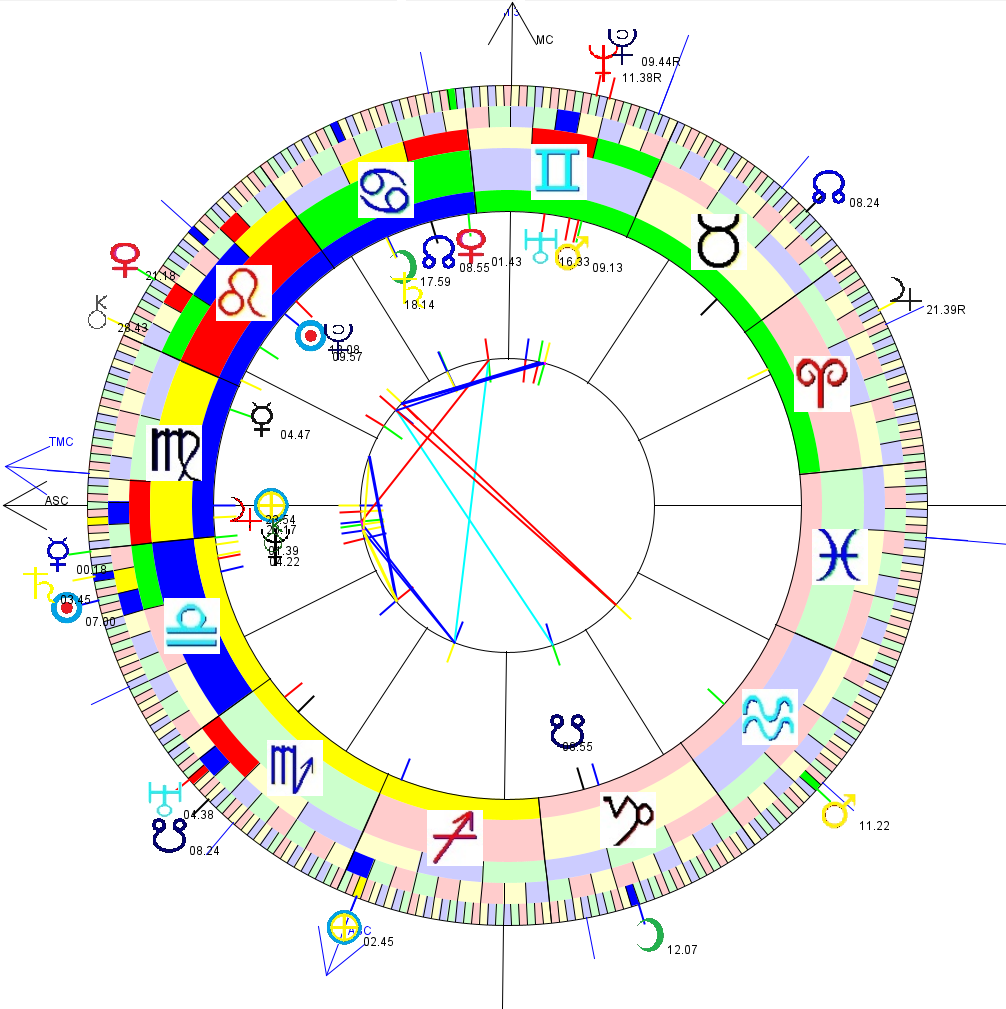
The astounding thing is, that seeing the astrological connections, it shows a meaningful link between events that are half a century apart, yet are connected by names, by history, and by astrology.
- Enola Gay's Mercury square the Hiroshima bomb's Venus
- Enola Gay's Mercury conjunct the Hiroshima bomb's Chiron
- Enola Gay's Mars opposite the Hiroshima bomb's Sun
- Enola Gay's Mars nearly trine the Hiroshima bomb's Mars
- Enola Gay's Mars opposite the Hiroshima bomb's Pluto
- Enola Gay's Saturn conjunct the Hiroshima bomb's Neptune
- Enola Gay's Uranus sextile the Hiroshima bomb's Mercury
- Enola Gay's Neptune sextile the Hiroshima bomb's Sun
- Enola Gay's Neptune sextile the Hiroshima bomb's Pluto
- Enola Gay's Pluto conjunct the Hiroshima bomb's Mars
- Enola Gay's Pluto sextile the Hiroshima bomb's Pluto
In the chart shown here, the inner chart is of the moment that Little Boy was detonated over Hiroshima, while the outer shows the day in 1892 when Enola Gay Haggard was born.
The two events are connected by some remarkable transits, especially the Mars Pluto connections..
Colonel Paul Tibbets
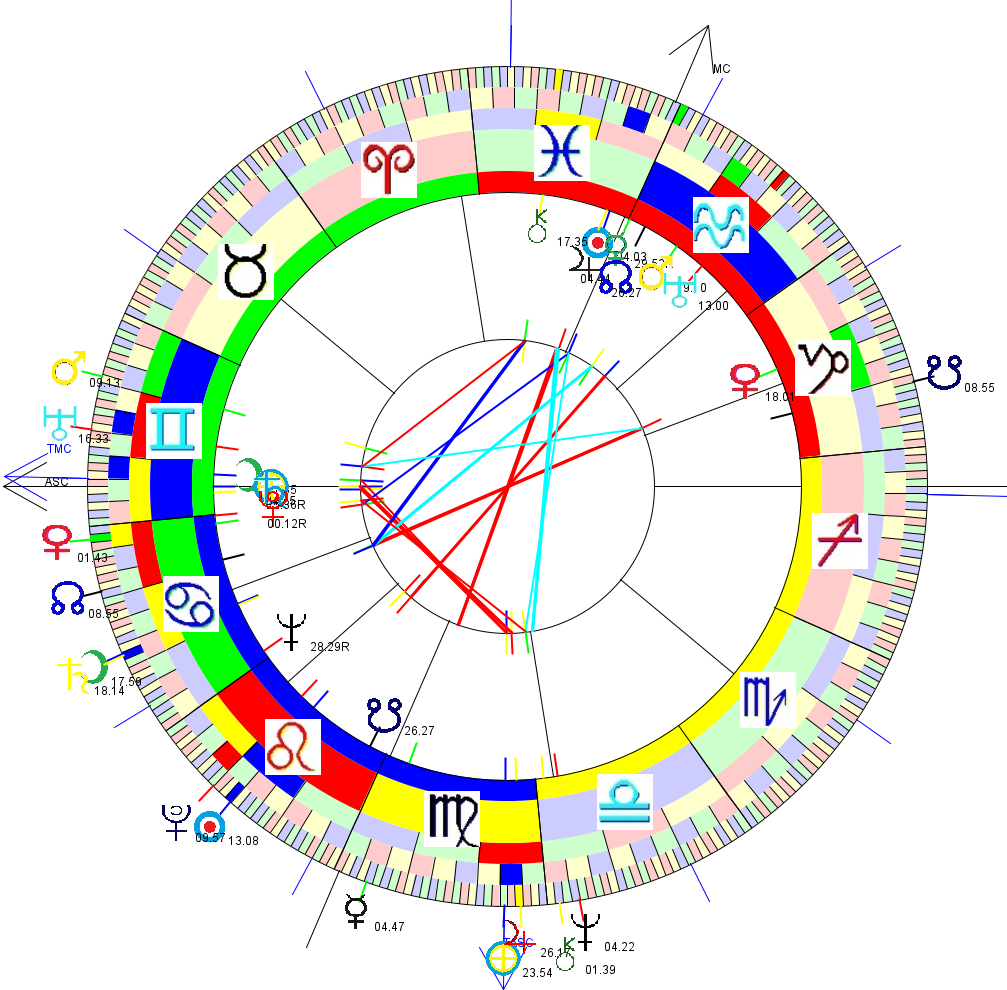
Paul Tibbets personally selected and named the aircraft after his mother and piloted it on the mission, making him the man most directly responsible for delivering the bomb. The astounding thing is how closely his own birthchart connects to the moment of detonation, given as a purely practical matter he could have piloted the mission on any number of different days.
- Transiting Earth square Paul Tibbets's Saturn
- Transiting Sun opposition Paul Tibbets's Uranus
- Transiting Moon opposition Paul Tibbets's Venus
- Transiting Moon trine Paul Tibbets's Chiron
- Transiting Mercury opposition Paul Tibbets's Sun
- Transiting Mercury opposition Paul Tibbets's Jupiter
- Transiting Venus trine Paul Tibbets's Mercury
- Transiting Venus conjunction Paul Tibbets's Pluto
- Transiting Jupiter square Paul Tibbets's Saturn
- Transiting Saturn opposition Paul Tibbets's Venus
- Transiting Saturn trine Paul Tibbets's Chiron
- Transiting Uranus square Paul Tibbets's Chiron
- Transiting Chiron square Paul Tibbets's Pluto
In the chart shown here, the inner chart is of midday on the day in 1915 when Colonel Paul Tibbets was born, while the outer shows the moment that Little Boy was detonated over Hiroshima.
The two events are connected by some remarkable transits, especially the tight aspects to Tibbets's own Sun and Saturn, which is exactly the kind of personal, identity-level connection you would expect to see at the moment someone carries out the single most consequential act of their life.
Tsutomu Yamaguchi
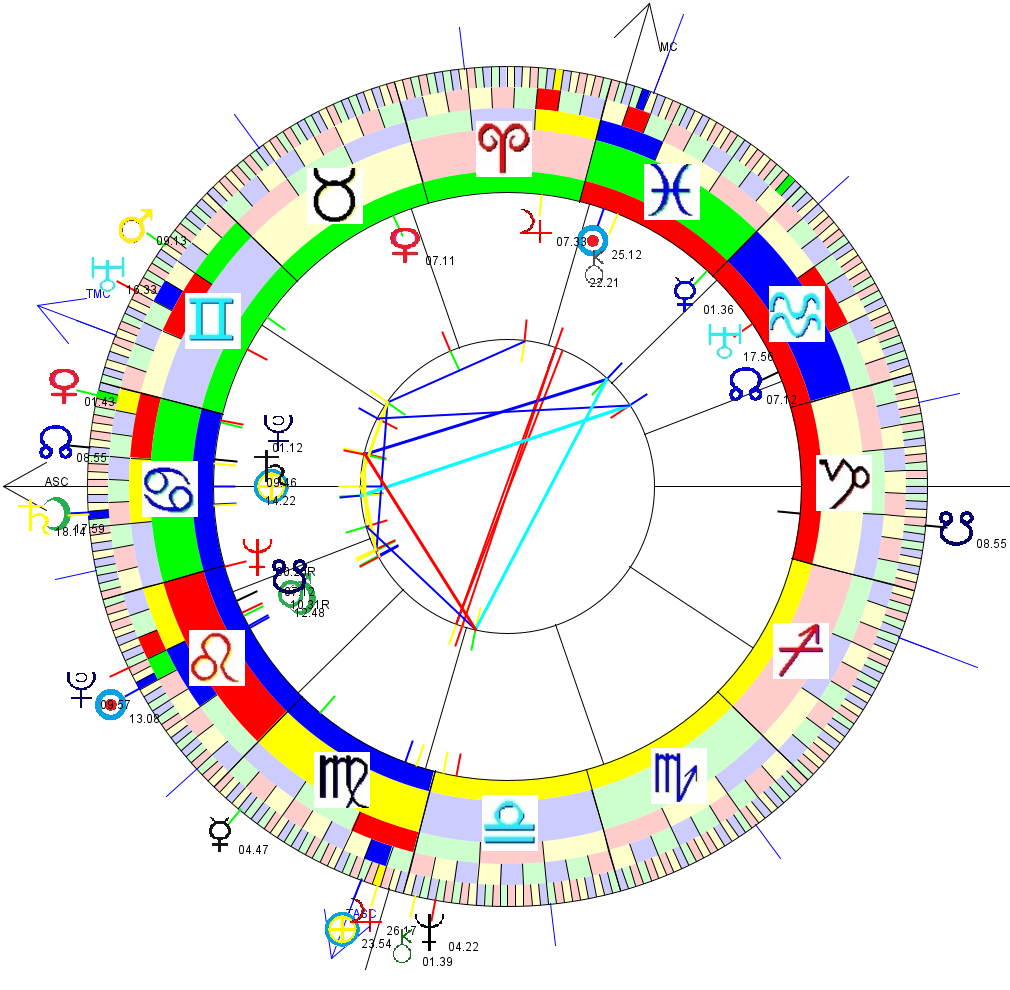
Tsutomu Yamaguchi was a Mitsubishi engineer who survived the Hiroshima bombing while on a business trip, then travelled home to Nagasaki in time to survive the second bomb three days later, making him the only person officially recognised by the Japanese government as a survivor of both attacks. The astounding thing is that his birthchart shows a repeated, almost doubled connection to the moment of the Hiroshima detonation, echoing the doubled nature of his own extraordinary survival.
- Transiting Earth opposite Tsutomu Yamaguchi's Sun
- Transiting Earth opposite Tsutomu Yamaguchi's Chiron
- Transiting Sun conjunct Tsutomu Yamaguchi's Moon
- Transiting Venus trine Tsutomu Yamaguchi's Mercury
- Transiting Venus conjunct Tsutomu Yamaguchi's Pluto
- Transiting Mars sextile Tsutomu Yamaguchi's Mars
- Transiting Mars sextile Tsutomu Yamaguchi's Jupiter
- Transiting Jupiter opposite Tsutomu Yamaguchi's Sun
- Transiting Chiron sextile Tsutomu Yamaguchi's Neptune
- Transiting Chiron square Tsutomu Yamaguchi's Pluto
- Transiting Uranus trine Tsutomu Yamaguchi's Uranus
- Transiting Pluto conjunct Tsutomu Yamaguchi's Mars
In the chart shown here, the inner chart is of the birth of Tsutomu Yamaguchi, set for midday because the time is unknown, while the transits show the moment that Little Boy was detonated over Hiroshima at 8:15am.
T.
Jacob Beser
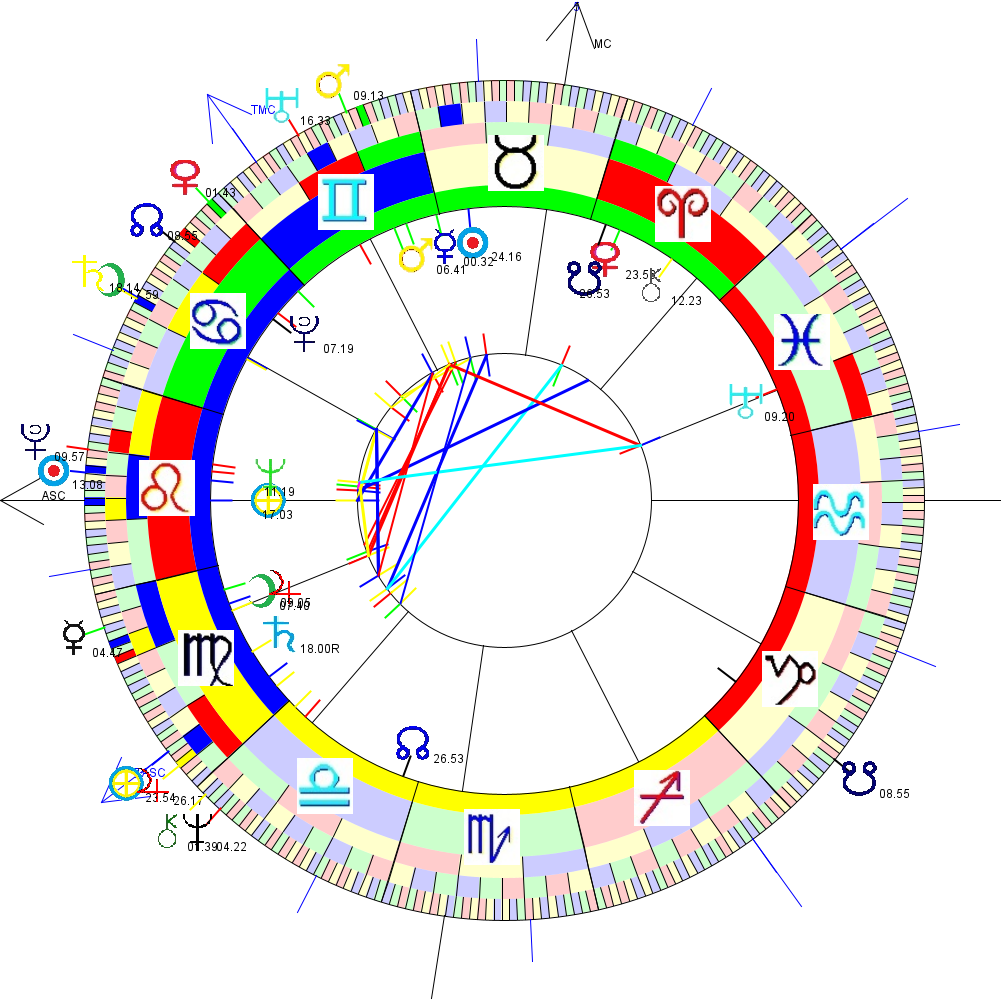
Jacob Beser was the radar countermeasures officer whose job was to make sure nothing jammed or accidentally triggered the bomb, and he is the only man known to have flown on both the Hiroshima and Nagasaki missions. The astounding thing is, again, how directly his own chart connects to the moment of detonation, given that of the entire crew he was one of only two men who flew on both raids.
- Transiting Earth trine Jacob Beser's Sun
- Transiting Sun conjunct Jacob Beser's Neptune
- Transiting Sun trine Jacob Beser's Chiron
- Transiting Moon sextile Jacob Beser's Saturn
- Transiting Mercury square Jacob Beser's Mars
- Transiting Mars square Jacob Beser's Jupiter
- Transiting Mars square Jacob Beser's Uranus
- Transiting Saturn sextile Jacob Beser's Saturn
- Transiting Chiron trine Jacob Beser's Mercury
- Transiting Uranus square Jacob Beser's Saturn
- Transiting Pluto conjunct Jacob Beser's Neptune
In the chart shown here, the inner chart is of the birth of Jacob Beser, set for midday because the time is unknown, while the transits show the moment that Little Boy was detonated over Hiroshima at 8:15am.
The two events are connected by ..
Wilfred Burchett visits Hiroshima
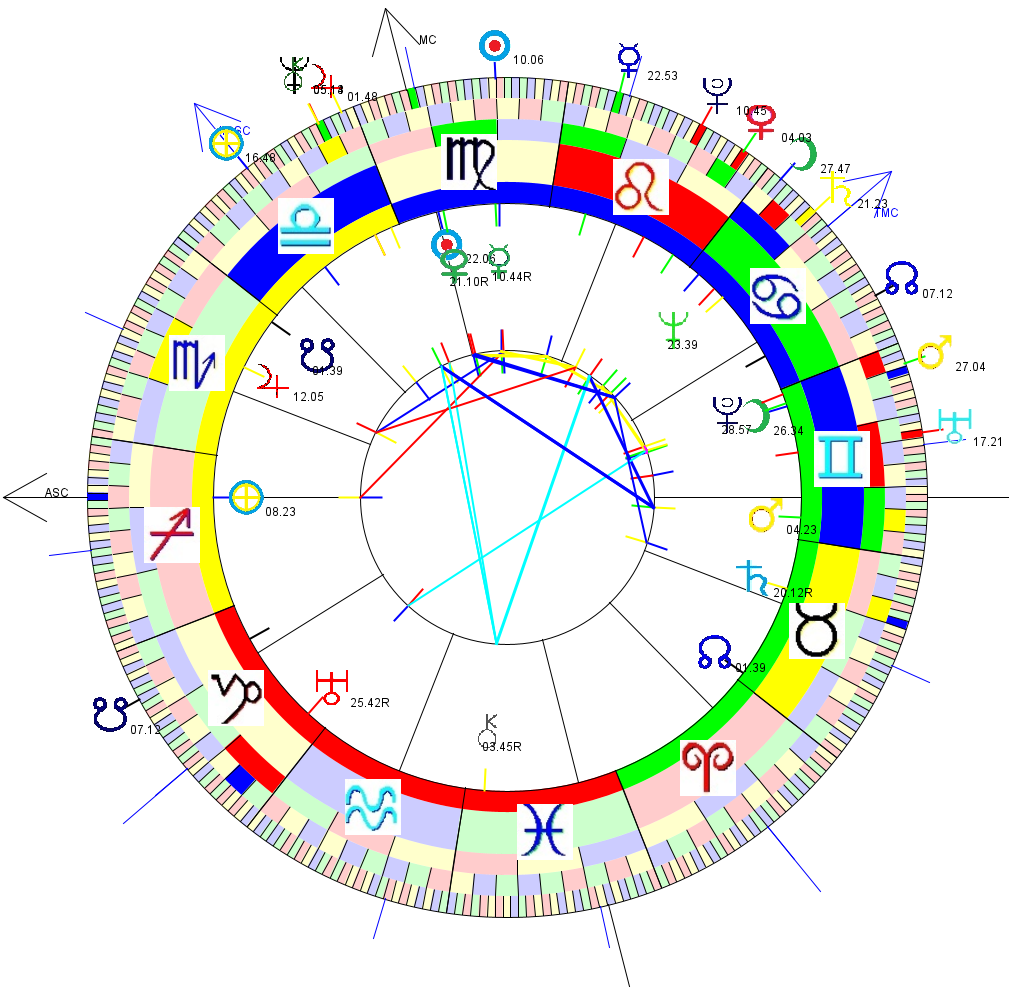
Wilfred Burchett, an Australian war correspondent, defied the US military's control of the press to travel alone to Hiroshima by train in September 1945, and filed the report 'The Atomic Plague', which was the first account to alert the world to the effects of radiation sickness, directly contradicting official US denials that the bomb had any lingering effects. The astounding thing is that his own chart shows a personal, activating connection to the city at the moment he arrived there, fitting for a story that became so personally defining for his career.
- Transiting Sun square Wilfred Burchett's Earth
- Transiting Sun conjunct Wilfred Burchett's Mercury
- Transiting Sun sextile Wilfred Burchett's Jupiter
- Transiting Venus sextile Wilfred Burchett's Mars
- Transiting Mars conjunct Wilfred Burchett's Moon
- Transiting Mars conjunct Wilfred Burchett's Pluto
- Transiting Saturn sextile Wilfred Burchett's Sun
- Transiting Saturn sextile Wilfred Burchett's Venus
- Transiting Saturn sextile Wilfred Burchett's Saturn
- Transiting Neptune trine Wilfred Burchett's Mars
- Transiting Pluto square Wilfred Burchett's Jupiter
- Transiting Chiron trine Wilfred Burchett's Mars
In the chart shown here, the inner chart is of the birth of Wilfred Burchett, set for midday because the time is unknown, while the transits show the time that he arrived in Hiroshima at 8:15am.
The two events are connected by ..

Leave a Comment
Thank you!
Your comment has been submitted and is awaiting moderation.
Comments
No comments yet.
 Go Home
 To encourage the rapid completion of this content, please feel free to donate on
Patreon
To encourage the rapid completion of this content, please feel free to donate on
Patreon This page is /menu/examples/politics/hiroshima.php and it was last updated on Wednesday 19th of August 2026 11:27:31 PM
© 2019-2026 Jeremy Corney. All rights reserved.